Publication
Carbon Dioxide Removal: Pathways and Policy Needs
Carbon dioxide removal (CDR) solutions will likely be needed to […]

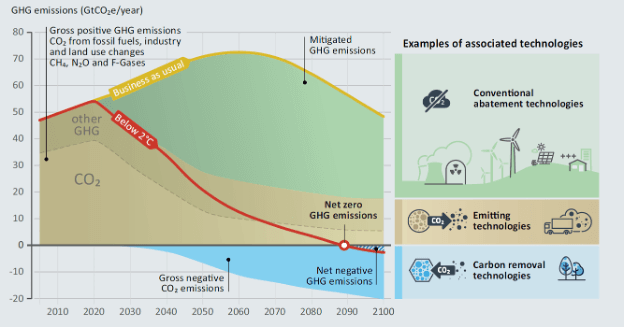
Net emissions (greenhouse gas emissions sources and sinks) must reach near zero by mid-century to meet the Paris Agreement targets of limiting warming to well below 2 degrees Celsius or a more aggressive target of 1.5 degrees. However, unavoidable emissions from hard-to-decarbonize sectors, like aviation, industrial processes, and the persistence of previously emitted greenhouse gases over the past 150 years, point to the need for “negative emissions”, the removal of carbon dioxide from the atmosphere using both nature-based and engineered solutions to lessen climate impacts.
Several recent studies—including the landmark 2018 Intergovernmental Panel on Climate Change (IPCC) special report on global warming of 1.5 degrees C—have emphasized the need for carbon dioxide removal (CDR) to reach global climate objectives and avoid the most severe consequences of climate change. Most of the mitigation pathways modeled in the report project the removal of carbon dioxide emissions using carbon removal solutions on the order of 100–1000 gigatons of carbon dioxide (GtCO2) by the end of the century. For reference, 100 gigatons, or 100 billion tons, of carbon dioxide is almost equivalent to the total U.S. emissions of carbon dioxide from 1990 to 2010.
The National Academy of Sciences, in turn, has estimated that to meet the Paris Agreement goals, 10 gigatons of carbon dioxide will need to be removed globally each year by around midcentury, with 20 gigatons of carbon dioxide removed each year by 2100. Similarly, the UN Environment Programme estimated that CDR needs to be deployed with a rapid scale-up to 8 gigatons of carbon dioxide per year by 2050 with a projected cumulative removal of 810 GtCO2 by 2100.
The process of carbon removal involves two main stages:
While there are different ways to categorize CDR solutions, they can be simply categorized according to their capture/removal mechanism—i.e., nature-based solutions and technological solutions.
Nature-based solutions: increase the biological uptake of carbon dioxide by increasing natural “sinks” or improving natural processes and practices. Nature-based solutions combine the capture and storage processes within the natural carbon cycle.
Technological solutions: utilize separate processes to first capture the carbon dioxide and then store it in dedicated geological reservoirs or long-lived materials.
There are specific criteria to assess the roles of different CDR approaches in comprehensive decarbonization strategies.
Removal potential |
How much carbon dioxide a given technique or technology can remove from the atmosphere. Removal potential is generally expressed in megatons of carbon dioxide (or, when other greenhouse gases are also involved, of carbon dioxide equivalents (CO2e)) that could be removed per year, as well as in terms of the overall capacity (in gigatons) that can be stored by a given date.
|
Economic costs |
The cost-effectiveness of different approaches (i.e., the bang for the buck) is a key consideration. To be able to compare the costs of different approaches, economic costs are generally expressed in terms of dollars per ton of carbon dioxide removed.
|
Durability |
Removing carbon dioxide from the atmosphere is only part of the challenge; it also has to stay stored/removed from the atmosphere for an extended period of time. The relative permanence of carbon dioxide removals—i.e., how easily removal/storage gains might be reversed—is thus of great relevance in evaluating CDR approaches.
|
Level of readiness |
Time is of the essence in addressing climate change, so how readyreadiness of CDR approaches are to be deployed must be a factor. The readiness criterion is of particular relevance to technological solutions, which are, generally speaking, less widely deployed than some nature-based counterparts.
|
Scalability |
CDR approaches do not just have to be deployed quickly; they also have to be deployed at scale in order to remove a sizeable amount of carbon dioxide. It is therefore important to consider how feasible it is for a CDR approach to achieve wide-scale deployment.
|
Sink saturation |
Once a CDR project is deployed, it can achieve carbon removals only until its sink or storage location for the captured carbon dioxide is full. It is helpful to consider how long any given type of CDR project will be providing removal benefits. |
Source: Mahmoud Abouelnaga, Carbon Dioxide Removal: Pathways and Policy Needs , (C2ES, 2021)
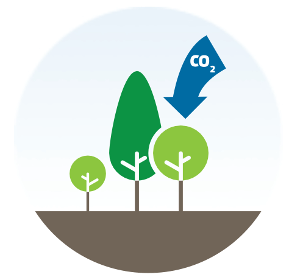 |
Afforestation and reforestation
Afforestation refers to the process of planting trees and forests in areas that historically did not have forests, while reforestation refers to the process of replanting trees in areas where existing forests have been depleted.
|
 |
Biochar
Biochar is a charcoal-like substance produced via pyrolysis (i.e., the thermal decomposition of organic material in the absence of oxygen). Biochar production converts biomass that might otherwise decay into a form that is relatively resistant to decomposition. When added to the soil, biochar stores carbon in a stable form that prevents it from leaking into the atmosphere.
|
 |
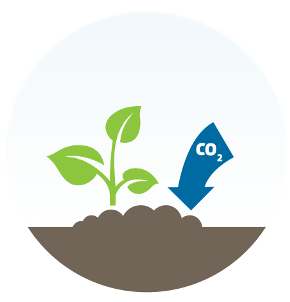
Soil carbon sequestration
Soil carbon sequestration refers to the process of removing carbon dioxide from the atmosphere by changing land management practices in a way that increases the carbon content of the soil. Since the level of carbon in soil is a balance of carbon inputs (e.g., from leaf litter, residues, roots, manure) and carbon losses (mostly through respiration, increased by soil disturbance), practices that either increase inputs or reduce losses can promote soil carbon sequestration.
|
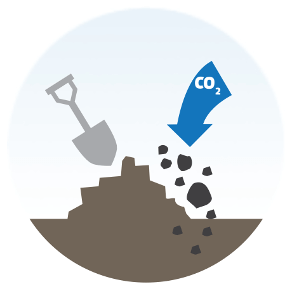 |
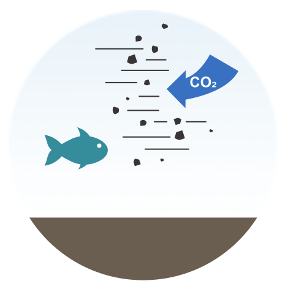
Enhanced weathering
Enhanced weathering refers to accelerating natural rock chemical breakdown by spreading large amounts of crushed minerals (e.g., pulverized silicate) onto warm and humid land areas to help absorb carbon dioxide from the air. |
 |
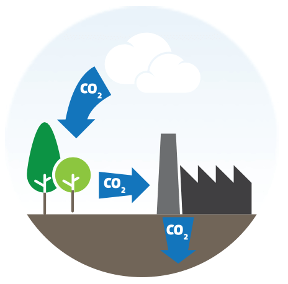
Ocean alkalinization
Ocean alkalinization refers to adding carbonate-containing minerals (alkaline solutions) to enhance the ocean’s natural carbon uptake. |
 |
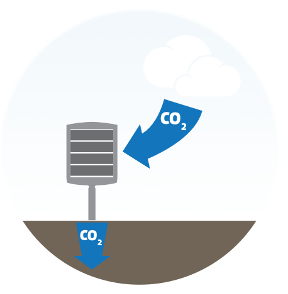
Biomass with carbon removal and storage (BiCRS)
Biomass with carbon removal and storage (BiCRS) is the process of using biomass to generate energy, capturing the released carbon dioxide, and storing it in underground geologic formations (or potentially utilizing it to make long-lasting products). |
 |
Direct Air Capture (DAC)
Direct air capture (DAC) involves direct removal of diluted carbon dioxide from ambient air via chemical bonding. Carbon dioxide is removed from ambient air by contact with a basic solution (chemical liquid solvents) or a basic modified surface (chemical solid sorbents). The carbon dioxide, now fixated in a carbonate or carbamate bond, can then be liberated from the capture media through the application of heat, producing a high-purity carbon dioxide stream that can be transported to storage sites or industrial plants for utilization.
|
Source: Adapted from Mercator Research Institute on Global Commons and Climate Change